
Rightsizing After an Empty Nest Starts With Your Life Now

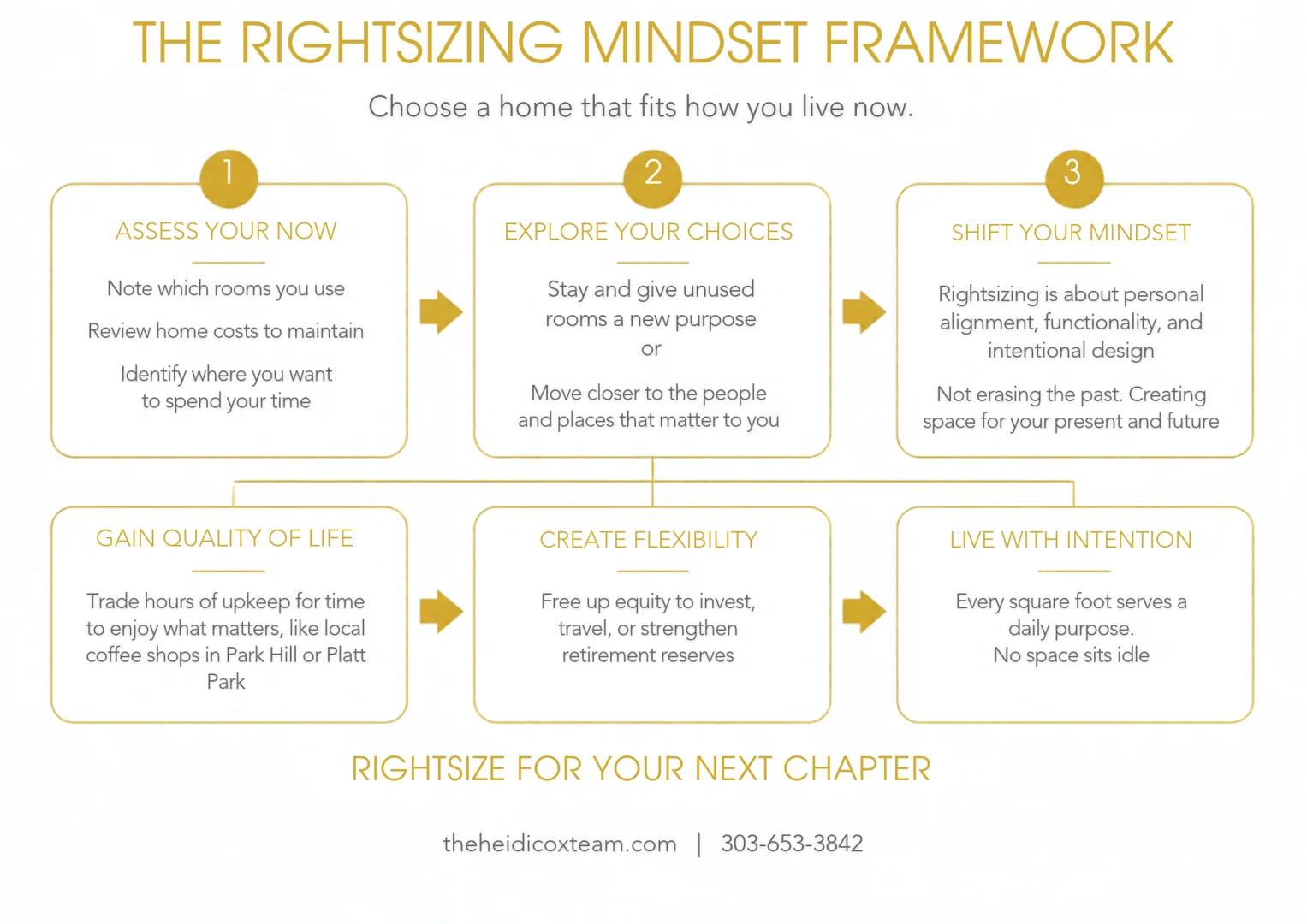
Rightsizing after an empty nest means choosing a home that fits how you live now, not simply finding a smaller one. Start by noting which rooms you use, what your home costs to maintain, and where you want to spend your time. You may decide to stay and give unused rooms a new purpose, or move closer to the people and places that matter to you. The same approach can help you find your footing after a divorce.
Heidi Cox is a Denver realtor with milehimodern who specializes in historic homes and helps clients navigate life transitions through real estate. She can help you weigh your space, costs, and neighborhood priorities so your next decision feels clear and grounded.
Rightsizing After Empty Nest: Defining Your Next Chapter

When major life transitions occur—whether your last child moves away for college or you are establishing personal independence post-divorce—your relationship with your home fundamentally changes. For years, your living space was designed around carpool schedules, sports gear storage, school boundaries, and busy shared routines. When those daily rhythms shift, many homeowners find themselves walking through quiet hallways and asking if their current footprint still aligns with their day-to-day reality.
Studies show that empty nesters face emotional barriers when considering moving, often hesitating for years because the family home represents decades of cherished memories. Acknowledging this emotional weight is an important part of the journey. Rightsizing is not about erasing the past; it is about intentionally creating space for your present and future priorities.
Downsizing vs. Rightsizing: Shifting the Mindset
The term "downsizing" often carries a negative connotation of sacrifice, loss, or settling for less. In contrast, rightsizing reframes the process around personal alignment, functionality, and intentional design. As professional organizer Sue Spencer notes in guidance on rightsizing for a new chapter, curating your living environment is about making room for the life you are actively living rather than remaining constrained by past stages.
When learning how to downsize in Denver, focusing on rightsizing shifts your perspective from square footage reduction to lifestyle enhancement. Instead of asking what you have to give up, you ask what you want to gain:
- Quality of life: Trading hours of yard upkeep for weekend mornings exploring local coffee shops in Park Hill or Platt Park.
- Financial flexibility: Freeing up trapped home equity to invest, travel, or strengthen retirement reserves.
- Spatial efficiency: Living in a home where every square foot serves a daily purpose rather than sitting idle.
Processing Major Life Transitions: Post-Divorce and Launched Kids
Navigating life after children leave or following a marital separation requires emotional bandwidth and self-compassion. In both scenarios, homes often hold reminders of former routines. It is common to feel a mix of grief and relief. Recognizing that feeling relief is a natural response to completing a demanding chapter of active parenting or relationship restructuring can help ease unnecessary guilt.
Your home is a setting for your life, but the memories, relationships, and personal growth reside with you. Establishing a new home base allows you to rediscover personal autonomy, choose design elements that reflect your individual taste, and build daily routines that bring you genuine joy.
Evaluating Your Space: Stay, Reset, or Move?
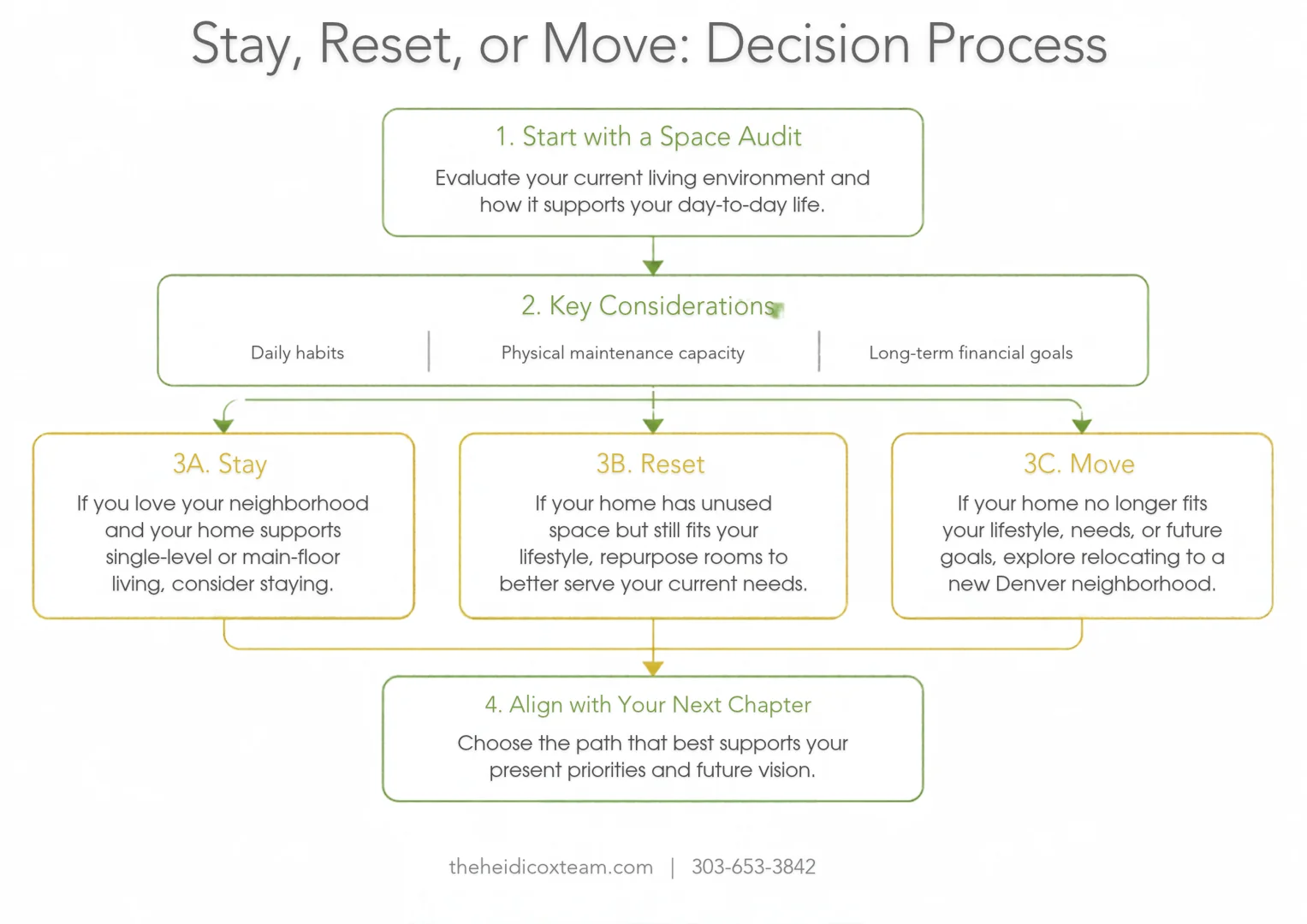
Before listing your property or scheduling viewings, take time to conduct a practical audit of your current living environment. Deciding whether to stay in place, reconfigure your existing floor plan, or relocate to a new Denver neighborhood depends on your daily habits, physical maintenance capacity, and long-term financial goals.
The Empty Nest Reset: Repurposing Unused Rooms
If you love your current neighborhood—such as the tree-lined streets of Congress Park or the quiet character of Southmoor Park—and your physical structure supports single-level or main-floor living, you might explore an in-place reset.
Globally, millions of homes maintain underutilized rooms once children depart. In Australia alone, an estimated 7.5 million homes contain spare or unused bedrooms. Rather than letting former kids' rooms turn into static shrines or makeshift storage units, consider repurposing them for your current interests:
- Dedicated creative studio: Convert an upstairs bedroom into an art, writing, or music studio with natural light.
- Executive home office: Design a quiet, ergonomic workspace tailored for remote work or consulting.
- Wellness and fitness room: Install gym flooring, mirrors, and free weights for home workouts.
- Flexible guest suites: Replace bulky youth furniture with a comfortable queen bed or sleeper sofa to accommodate visiting adult children without keeping the room frozen in time.
Calculating True Carrying Costs and Hidden Overhead
A large family home that is paid off is not free to carry. Even without a monthly mortgage payment, oversized properties incur continuous holding costs through property taxes, hazard insurance, heating and cooling bills, roof and HVAC replacements, and routine landscaping.
When exploring comprehensive financial planning in Denver, it is helpful to calculate your total monthly carrying costs. Heating an underutilized 4,000-square-foot house during Colorado winters or watering an expansive lawn during dry summers can divert significant capital away from retirement or personal travel. Rightsizing to an energy-efficient footprint immediately trims these ongoing overhead expenses.
Financial Freedom: Equity, Taxes, and Long-Term Wealth

One of the most compelling aspects of rightsizing after an empty nest is the opportunity to convert illiquid real estate equity into accessible financial strength.
Financial and Tax Advantages of Rightsizing After Empty Nest
Long-term Denver homeowners often hold substantial equity built over years of steady appreciation. Under IRS Section 121, married couples filing jointly can exclude up to $500,000 of capital gain from federal income taxes on the sale of their primary residence, while single filers can exclude up to $250,000, provided they have lived in the home for at least two of the previous five years.
Understanding these tax guidelines, as highlighted in analysis of the dual benefits of rightsizing and tax advantages, allows sellers to protect substantial proceeds. Beyond capital gains advantages, transitioning to a smaller home often results in lower annual property tax assessments and reduced homeowner insurance premiums.
Reallocating Equity for Retirement and Lifestyle Goals
The capital freed up during a rightsize can significantly alter your retirement timeline. For instance, a couple moving from a 5,000-square-foot home to a 2,000-square-foot property could save an estimated $50,000 per year in combined mortgage, utility, maintenance, and tax expenses. Investing that annual savings with an average 6 percent return can generate approximately $660,000 in additional retirement wealth over a 10-year span.
To understand your current equity position, start by evaluating what your Denver home is worth in today's local market. This baseline number clarifies whether you can purchase your next home with cash, reduce your loan balance, or reallocate excess proceeds into diversified retirement assets.
Practical Steps to Declutter and Transition Smoothly
Decluttering a home accumulated over 20 to 30 years can feel daunting. Breaking the transition into clear, manageable steps prevents burnout and keeps emotional energy high.
Practical Decluttering Steps for Rightsizing After Empty Nest
A smooth transition begins 6 to 18 months before your planned move. Tackle your belongings room by room using a structured approach:
- Start with low-emotion spaces: Begin in utility areas like the laundry room, pantry, or linen closet. This builds momentum before tackling sentimental spaces.
- Sort by category, not just room: Gather items like books, linens, or duplicate kitchenware into one spot to clearly see how many duplicates you own.
- Establish four distinct piles: Keep, Sell, Donate, and Discard. If an item does not support the daily life you live now, let it go.
- Address oversized furniture early: Identify bulky sectionals or large dining sets 6 to 9 months ahead of moving. Selling or gifting these items early simplifies staging.
- Seek objective support: If the process feels heavy, working alongside a professional organizer or trusted friend can make decision-making far easier, similar to the process used when helping aging parents downsize in Denver.
Communicating with Adult Children and Setting Boundaries
Adult children often leave boxes of schoolwork, trophies, and childhood furniture in their former bedrooms simply out of convenience. When preparing to rightsize, clear communication is essential:
- Set a definitive pickup deadline: Give your adult children several months' notice to claim items they want to keep in their own homes.
- Digitize sentimental paper: Photograph vintage artwork, school projects, and scrapbooks to create digital photo albums without storing bulky physical boxes.
- Release guilt over heirlooms: If your children do not have room for formal china cabinets or heavy wooden bedroom sets, permit yourself to donate or sell them. True family connection is maintained through relationships, not stored furniture.
Exploring Denver Housing Options for Your Next Chapter
Denver offers a diverse selection of housing styles suited for buyers seeking lower maintenance, single-level living, or vibrant walkable neighborhoods.
Comparing Low-Maintenance Housing Styles in Denver Metro
Choosing the right property type depends on how much maintenance you want to delegate and the type of community environment you prefer:
| Housing Style | Best Suited For | Maintenance Responsibilities | Denver Metro Neighborhood Examples |
|---|---|---|---|
| Boutique Condominiums | Lock-and-leave lifestyle, urban walkability, no exterior chores | HOA covers exterior, roof, grounds, and common areas | Cherry Creek, Cheesman Park, Golden Triangle |
| Low-Maintenance Townhomes | Multi-level privacy, private garages, minimal yard work | HOA manages exterior structure, roof, and lawn care | Central Park, Highlands, RiNo, Sloan's Lake |
| Single-Story Patio Homes | Single-level living, private outdoor patio, low maintenance | HOA handles landscape maintenance and snow removal | Southmoor Park, University Park, Littleton suburbs |
| 55+ Active Adult Communities | Social programming, resort amenities, age-aligned peer group | Comprehensive HOA coverage of exterior and amenities | Heritage Eagle Bend, Heather Gardens, Windsor Gardens |
For those prioritizing walkability and cultural access, downsizing to a condo in Cherry Creek offers close proximity to local boutiques, dining, and walking paths. Homeowners seeking dedicated amenities and social programming can also explore various Denver senior living community options and active adult developments across the metro area.
Preparing and Staging Your Denver Home for Sale
When listing a long-term family home, thoughtful preparation ensures you maximize market value while appealing to modern buyers.
- Refresh surfaces: A fresh coat of neutral interior paint and updated light fixtures modernize older floor plans.
- Review staging options: Reviewing Denver home staging cost considerations helps you budget effectively for professional staging that highlights spatial flow.
- Incorporate proven staging principles: Applying practical home staging tips for Denver sellers helps highlight architectural character and natural light.
- Execute a clear sale plan: Working with experienced local representation ensures you are navigating a Denver home sale smoothly from initial pricing to final closing.
Frequently Asked Questions About Rightsizing in Denver
When is the ideal time to begin the rightsizing process?
The ideal timeframe is 12 to 24 months before your target move date. Starting early allows you to declutter gradually, plan necessary minor home updates, explore target neighborhoods without pressure, and align your listing with peak Denver spring or summer market seasons.
How do capital gains tax exemptions apply when selling my family home?
Under current federal tax code, married couples filing jointly can exclude up to $500,000 of capital gain ($250,000 for single filers) if the home served as their primary residence for at least two of the five years preceding the sale date. Always consult your CPA to review your specific tax basis and capital improvement records.
What if my adult children want me to keep their childhood bedrooms intact?
Have an empathetic, direct conversation explaining that your home needs to evolve to support your current daily needs. Offer to save specific meaningful keepsakes or take high-resolution photos of the room before converting it into a versatile guest space that still warmly welcomes them when they visit.
Conclusion: Designing a Home That Fits Your Present Life
Rightsizing is an empowering opportunity to align your living space with the life you want to lead today. Whether that means moving into a walkable urban condo, settling into a low-maintenance patio home near Denver parks, or reimagining your current rooms, this transition gives you the freedom to focus on wellness, relationships, and financial peace of mind.

If you are ready to explore your housing options and get the process started by working with The Heidi Cox Team, we are here to help you evaluate your home's equity, review local neighborhood choices, and navigate every step with clarity and care. Contact us today for expert guidance for selling your Denver home or reach out directly to contact The Heidi Cox Team to begin planning your next chapter.