
Denver Historic District Rules: What to Check Before You Buy or Renovate

If you're looking at a home in a Denver historic district, the first thing to know is that the rules are about the outside of the house. Windows, porches, additions, garages and anything else that changes the exterior go through the city's Landmark Preservation review before you can pull a permit. Kitchens, baths and floor plans are generally yours to change.
I'm Heidi Cox, a Denver REALTOR® with milehimodern, and I spend a lot of my time in historic homes in neighborhoods like Park Hill and Curtis Park. I think the review process scares people off more than it should.
My advice is simple. Check the address on Denver’s historic district map before you write an offer, and call Landmark staff before you buy materials.
Denver historic district history, significance, and standout examples
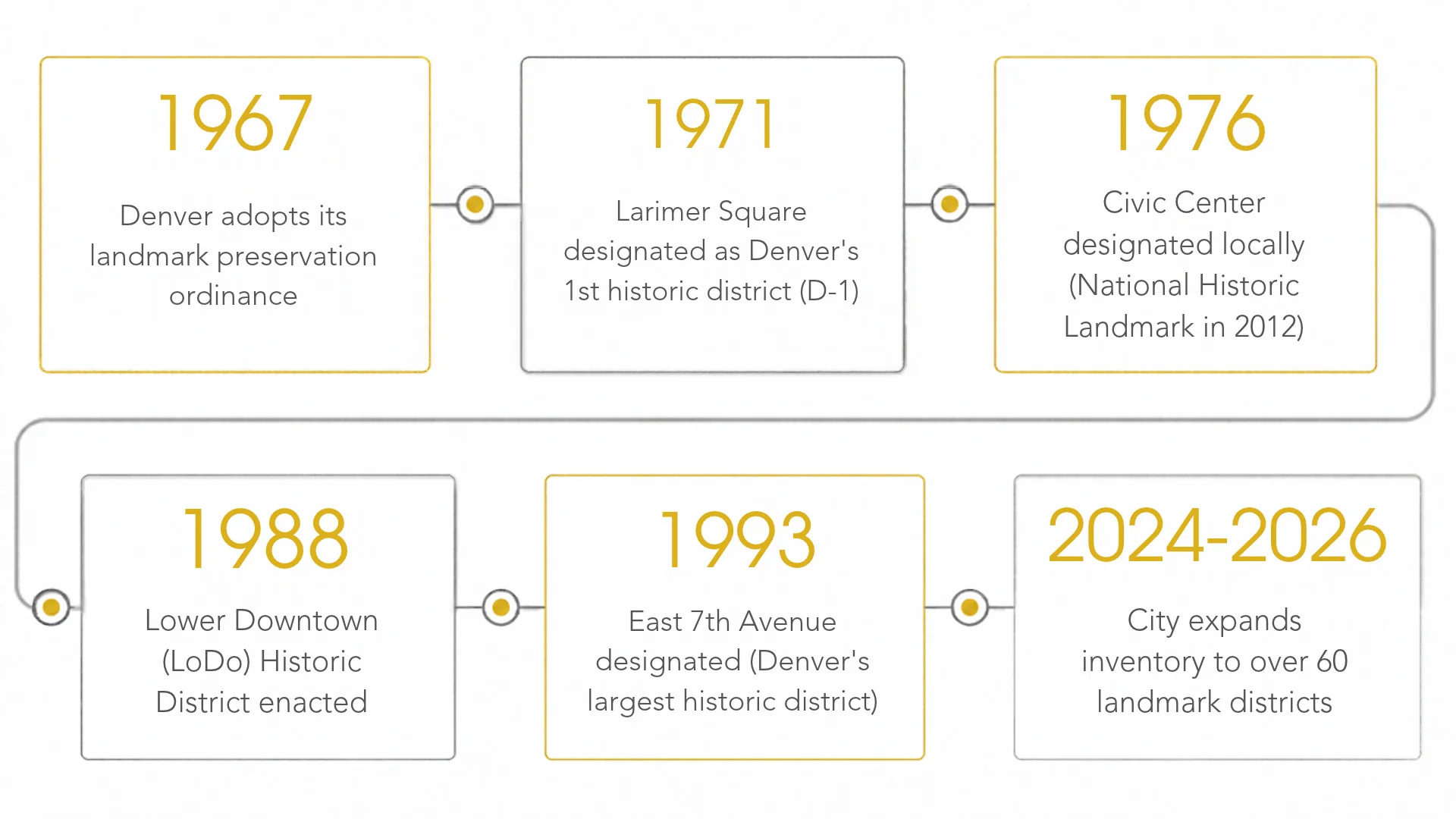
Denver has been protecting historic buildings for more than half a century. City Council passed the landmark preservation ordinance in 1967. Four years later, in 1971, Larimer Square became Denver's first locally protected historic district, and it was added to the National Register of Historic Places in 1973.
You can pull up the official Denver historic districts and landmarks map to see where the protected areas are, from downtown out into the neighborhoods.
How Denver’s preservation movement grew
During the urban renewal years of the 1950s and 1960s, a lot of Denver's early commercial blocks were being torn down. Dana Crawford pulled together investors in the 1960s to buy and restore the Victorian commercial buildings along Larimer Street, and showed that reusing old buildings could bring business back.
Other parts of the city followed:
- Lower Downtown (LoDo): Enacted as a historic district in 1988, LoDo transformed from a declining warehouse sector into a vibrant cultural, dining, and residential anchor.
- Corridor Initiatives: Historic corridors like Colfax Avenue adopted context-sensitive zoning and heritage tourism strategies to encourage reinvestment while maintaining neighborhood transitions.
- Economic Resilience: Preservation emerged as an engine for sustained local business, attracting residents who value craftsmanship and community identity over cookie-cutter developments.
Historic districts that show Denver’s range
The districts cover a wide range of eras and building types:
- Civic Center Historic District: Centered around Civic Center Park, this district reflects the City Beautiful movement and classical Beaux-Arts architecture. Influenced by Mayor Robert W. Speer's early 20th-century civic vision, it was designated locally in 1976 and became a National Historic Landmark in 2012.
- East 7th Avenue Historic District: Designated in 1993, this is Denver's largest historic district. Stretching from Logan Street to Colorado Boulevard, it has parkways designed with input from the Frederick Law Olmsted firm and city landscaper Saco DeBoer, lined with large homes built from the 1890s through 1930.
- Lower Downtown (LoDo): LoDo is multi-story brick warehouses, timber framing and old rail spurs from Denver’s industrial rail-hub heyday.
- Curtis Park: As Denver's oldest residential suburb, Curtis Park has Italianate, Queen Anne and other Victorian homes. Explore Curtis Park’s historic homes and architecture to see how early streetcar lines shaped neighborhood character.

Larimer Square’s 2018–2020 redevelopment debate
Between 2018 and 2020, Larimer Square became the center of a national conversation when proposals surfaced to introduce high-rise towers, including one conceptualized up to 40 stories, which would have involved partial demolition of historic structures. The proposal sparked deep concern from preservation advocates and civic leaders.
Organizations like Historic Denver, Inc. mobilized the community, underscoring that altering foundational protections would establish an unpredictable precedent for all protected neighborhoods. In December 2020, North Carolina-based Asana Partners purchased the block, committing to rehabilitate and preserve the historic buildings within their existing footprints while introducing compatible modern upgrades. This outcome proved that historic districts can evolve dynamically without sacrificing their scale, integrity, or legal safeguards.
How designation, protections, and owner applications work
Understanding landmark status helps homeowners plan renovations smoothly. Denver categorizes preservation into individual landmarks and landmark districts, cross-referencing contributing and non-contributing structures. You can review all protected neighborhoods using Denver’s official historic district list.
How a Denver historic district earns designation
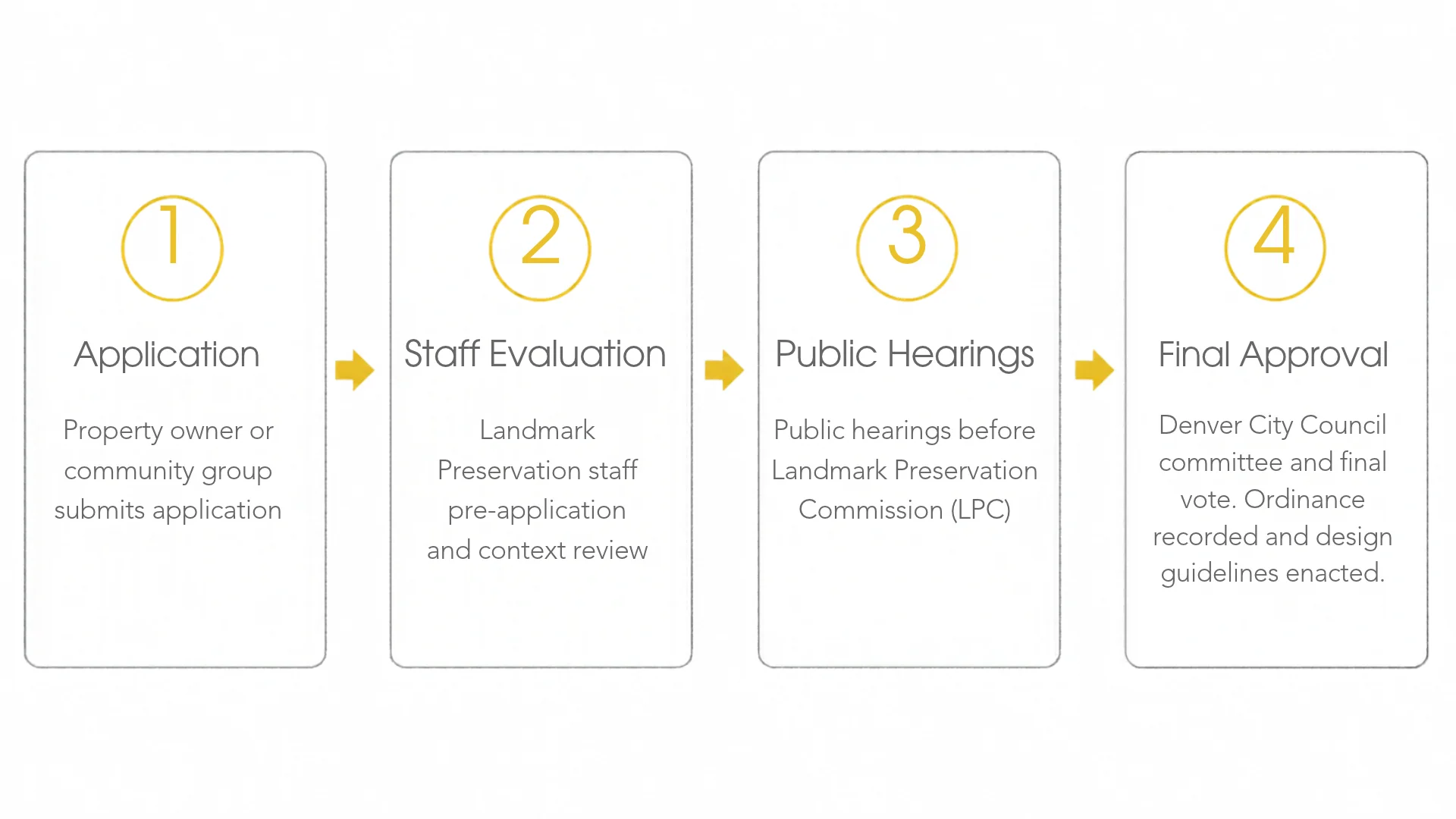
Creating a new district or listing an individual building follows a clear civic path:
- Application: Property owners or neighborhood groups compile historical documentation and submit an application to Landmark Preservation staff.
- Staff Evaluation: City planners evaluate the nomination against official criteria and help refine boundaries and periods of significance.
- Public Hearings: The Landmark Preservation Commission holds public meetings to review community input and historical merit.
- City Council Adoption: If approved by the commission, the nomination goes before Denver City Council for an official ordinance vote.
To begin researching a nomination or check current applications, you can explore how to apply for historic designation directly through Community Planning and Development.
Denver’s ten landmark designation criteria
Under Chapter 30 of the Denver Revised Municipal Code, a site or neighborhood must demonstrate significance across three broad categories, History, Architecture, and Geography, using Denver's 10 landmark criteria:
- History: Direct association with significant historical events, eras, or patterns of development; association with influential historical figures; or exemplification of the city's cultural heritage.
- Architecture: Embodiment of a distinctive architectural style; representation of master craftsmanship; work of an influential architect; or recognition as a rare, surviving structural type.
- Geography: Presence as a familiar visual landmark or physical focal point in a neighborhood; integration into a distinctive parkway or streetscape layout; or representation of an established urban identity.
When planning exterior updates, owners should consult the city's guide to character-defining features to ensure original elements like masonry, porches, and rooflines are respected.
What changes need review in a Denver historic district
All properties inside a designated district boundary, including contributing homes, non-contributing structures, and vacant parcels, are subject to exterior design review before building permits are issued. Interior remodels do not require landmark review unless they alter exterior walls or windows.
Key exterior updates requiring review include:
- Window and exterior door replacements
- Porch alterations or rebuilds
- Siding, brick repointing, and exterior material modifications
- Additions, pop-tops, dormers, and new garage construction
- Commercial signage, storefronts, and major site features
- Demolition of primary or accessory structures
Reviews are conducted by Landmark Preservation staff or the Landmark Preservation Commission (and the Lower Downtown Design Review Commission for properties in LoDo). For practical tips on preparing permit packages, check our Denver landmark review guidance.
Height limits, incentives, and the balance between preservation and change
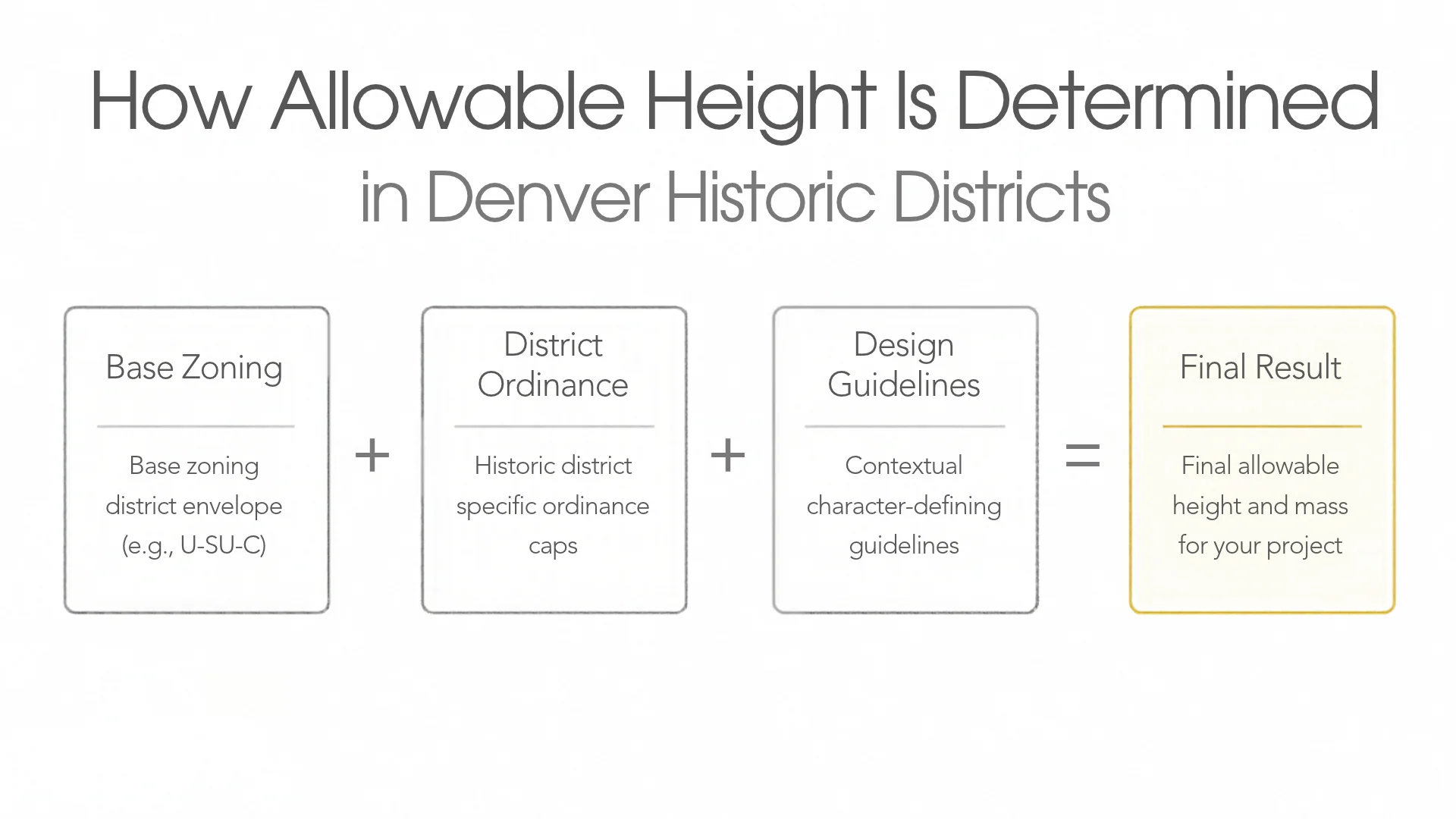
There is no single, uniform height cap that applies across all historic districts in Denver. Instead, building heights and bulk standards are determined by combining:
- Underlying base zoning (such as U-SU or C-MX standards)
- Specific district designation ordinances
- Neighborhood-specific design review guidelines
To offset the costs of specialized craftsmanship and materials, owners of historic properties have access to compelling financial incentives:
| Designation Type | Local Design Review Required? | Demolition Protection? | Federal Tax Credit Eligible? | Colorado State Tax Credit Eligible? |
|---|---|---|---|---|
| Local Historic District (Contributing) | Yes | Yes (LPC Review) | Income-producing properties only (if National Register listed) | Yes (Residential & Income-Producing) |
| Local Individual Landmark | Yes | Yes (LPC Review) | Income-producing properties only (if National Register listed) | Yes (Residential & Income-Producing) |
| National Register of Historic Places Only | No (Unless local overlay exists) | No (Federal review only for federal funds) | Yes (Income-Producing Only) | Yes (State Register mirror) |
The Colorado State Historic Preservation Tax Credit allows eligible homeowners to claim income tax credits on qualified rehabilitation expenses for non-income-producing residential properties. I'd talk to a tax advisor before you plan around either credit.
Who helps owners and applicants navigate the process
You do not have to interpret these guidelines alone. Denver's preservation community offers several supportive touchpoints:
- Landmark Preservation Staff: Municipal staff within Community Planning and Development provide pre-application consultations and help interpret design guidelines.
- Historic Denver, Inc.: This local non-profit offers education, technical guidance, and advocacy for homeowners undertaking sensitive renovations.
- Advisory Council on Historic Preservation (ACHP): Oversees federal Section 106 reviews when public funds or federal undertakings intersect with local historical assets.
- Denver 3-1-1: Connects you quickly with city planning staff for questions on property status and permit routing.
Frequently Asked Questions about Denver Historic Districts
Before buying or renovating, exploring Denver’s historic designation process and resources will give you a clear look into city regulations and staff support.
How many historic districts and individual landmarks does Denver have?
Denver currently includes 60 historic districts and over 370 individual landmarks, encompassing roughly 4.5% of the city’s primary structures. To check a specific property, download the city's latest individual landmark list.
How can I check whether a property is designated, and what should I know before renovating?
To verify landmark status, enter the address into the city’s interactive mapping portal. If your address falls within a district or has a marker, schedule a quick discovery call with city staff before purchasing materials. To learn more about buying or owning classic architecture across the metro area, read our guide to Historic homes in Denver.
Is Larimer Square part of LoDo, and can historic districts change?
Larimer Square is directly adjacent to Lower Downtown but exists as an independent historic district (D-1), established 17 years before LoDo was enacted in 1988.
Historic districts are not frozen in time; they are designed to accommodate thoughtful change. Renovations, modern interior floor plans, and compatible new construction are welcomed, provided exterior additions respect the scale, rhythm, and materials of the surrounding neighborhood context.
Conclusion
What I love about Denver's historic districts is that the things that make them special are protected. The porches, the brick, the scale of the street.
The tradeoff is a little more planning on the front end. I don't think that's a reason to walk away from a house you love, but I do think you should know what you're signing up for before you close.

If you're thinking about buying or renovating in one of Denver's historic districts, explore Denver home-buying guidance or reach out to get the process started. I'm always happy to talk it through.